Project overview
Project details
- Client
- Confidential
- Year
- 2026
- Category
- District Cooling
- Location
- Greater Cairo, Egypt
- ASME B31.1
- ASME B16.5
- Bentley HAMMER
- CAESAR II
- Revit
- Surge Analysis
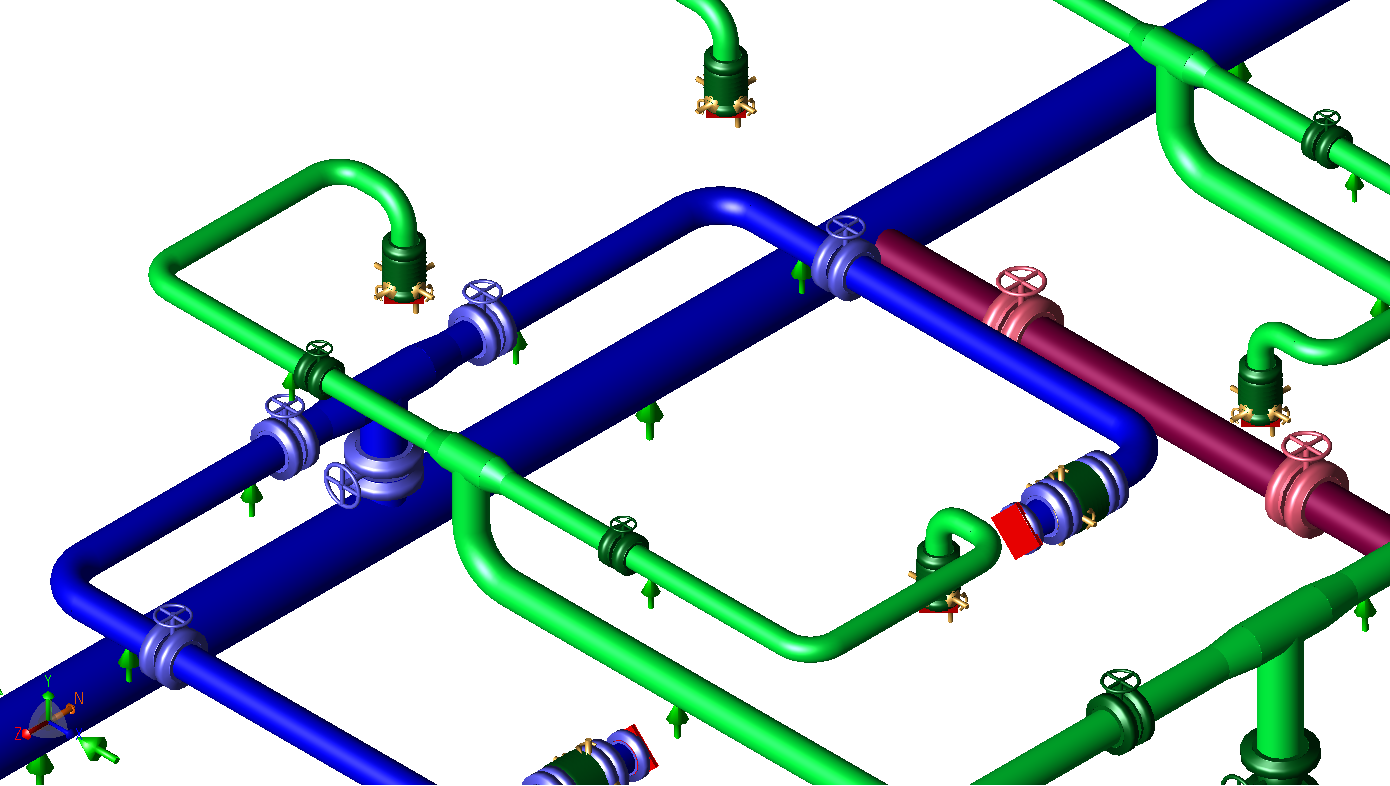
Pipe stress and flexibility analysis of a DN 600 to DN 200 condenser water riser and cooling tower distribution system in Greater Cairo. The scope covers seismic, settlement, expansion joint, spring support, nozzle load and hydraulic transient analysis.
Project and client identifying information is withheld under a confidentiality agreement.
- 883 l/sriser flow to four towers
- 24load cases
- 64.5%peak stress ratio
The challenge
- A 600 mm carbon steel condenser water riser carries 883 l/s from plant level to four rooftop cooling towers at +20.9 m.
- The system has to accommodate about 70 mm of differential settlement between supporting structures.
- The equipment vendor never issued cooling tower nozzle allowables, so the piping was arranged to minimise nozzle loads instead of being checked against a stated limit.
- Simultaneous tripping of four pumps on power failure was the governing transient case.
Our approach
- The full riser and rooftop distribution was modelled in CAESAR II.
- Untied expansion joints absorb settlement, and tied joints are used at every tower connection.
- Support locations were tightly limited by the shaft and rooftop layout, so the design relied on guides, limit stops and expansion joint placement instead of support quantity.
- Variable spring hangers were sized and selected for the DN 600 riser supports, with hot loads of 112 kN and 108 kN.
- Support types, gaps and reaction loads were issued on marked-up general arrangement drawings, with a proposed support detail and U-bolt detail drawings.
- The hydraulic transient study was run separately in Bentley HAMMER for a full pump-trip event, using the Method of Characteristics.
- Revit 3D modelling coordinated the plant and riser piping with the architectural and structural models. Spans and clashes, including weld positions, were corrected to make the arrangement installable.
The outcome
- All load cases qualified to ASME B31.1, with a peak stress ratio of 64.5%.
- Nozzle loads at all four cooling towers were held to single-digit kN, despite having no vendor allowables.
- The 70 mm differential settlement was absorbed without transferring load into the riser.
- Both variable spring hangers (112 kN and 108 kN hot load) showed 1–2% load variation, against a 25% code allowance.
- The transient analysis gave a maximum pressure of 4.92 bar against a 16 bar pipe rating, and a minimum of about 0 bar against a −1 bar limit. No surge vessels, anticipator valves or other protection equipment were needed.
- The analysis covered 24 load cases, including four-directional seismic.
- Deliverables: revised support locations, cooling tower nozzle loads, support reactions and main anchor loads of up to 457 kN axial, issued as marked-up general arrangement drawings for structural design and installation.
Codes, standards and tools
- ASME B31.1
- ASME B16.5
- Hazen-Williams
- Korteweg
- CAESAR II V11
- Bentley HAMMER
- Revit