Project overview
Project details
- Client
- EPC contractor (oil storage and terminals)
- Year
- 2025
- Category
- Firefighting
- Location
- Suez, Egypt
- ASME B31.3
- ASME B31.4
- CAESAR II
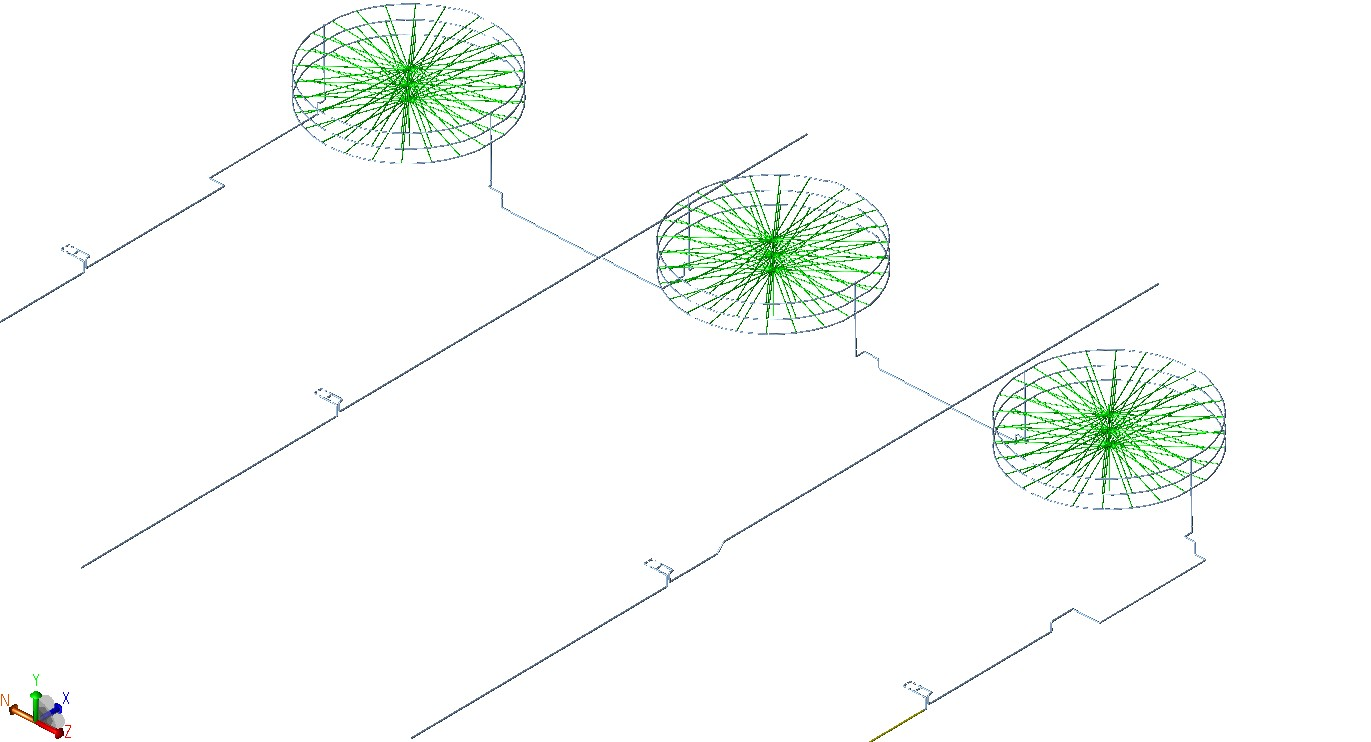
Pipe stress and flexibility analysis of a firefighting and shell-cooling ring system serving six crude oil storage tanks, with buried distribution headers and shell-mounted cooling rings. The whole system was analysed as a single dual-code model, with seven thermal states resolved across twenty-one expansion range combinations.
- 6crude oil tanks
- 93load cases
- 83%governing expansion, of allowable
The challenge
- Cooling rings are closed circuits clamped to the tank shell, with no natural offset or direction change to absorb thermal growth. The shell attachments act as the anchor points.
- Expansion in one ring is resisted by the buried header network, which the soil restrains along its full length.
- Buried restrained pipe follows different stress formulations, allowable bases and thermal strain treatment than above-ground piping, yet the two are continuous at every tank entry. Separate models would have needed assumed boundary conditions at the least certain locations.
- The system stays at ambient standby for most of its life and reaches operating temperature only during a fire or cooling event, across Suez ambient conditions. The governing thermal cycle was therefore not obvious in advance.
Our approach
- One continuous CAESAR II model covering buried headers, tank feeds, branch lines and shell rings.
- Soil restraint applied over the buried sections at 1.5 m cover.
- Code switched at the buried-to-above-ground transition: ASME B31.4 for buried restrained lengths and ASME B31.3 for above-ground lengths.
- Seven thermal states: operating, design, three process scenarios, maximum ambient and minimum ambient.
- All twenty-one pairwise combinations of those states built as explicit expansion range cases.
- Occasional loads: wind in four directions, seismic in both horizontal axes at both signs, and two discrete occasional force cases, each combined with sustained loading.
- 93 load cases in total.
The outcome
- Qualified in full, with zero code violations across all cases.
- Expansion range governed at 83% of allowable. Occasional loading (sustained plus wind) reached 59%, sustained loading peaked at 53% and hydrotest reached 39%.
- Where flexibility was inadequate, routing changes were defined and returned to the 3D model instead of adding restraints.
- Support types and loads were issued in local coordinates for structural design.